Agent-to-Agent Communication: Solving the Hardest Problem in Multi-Agent AI
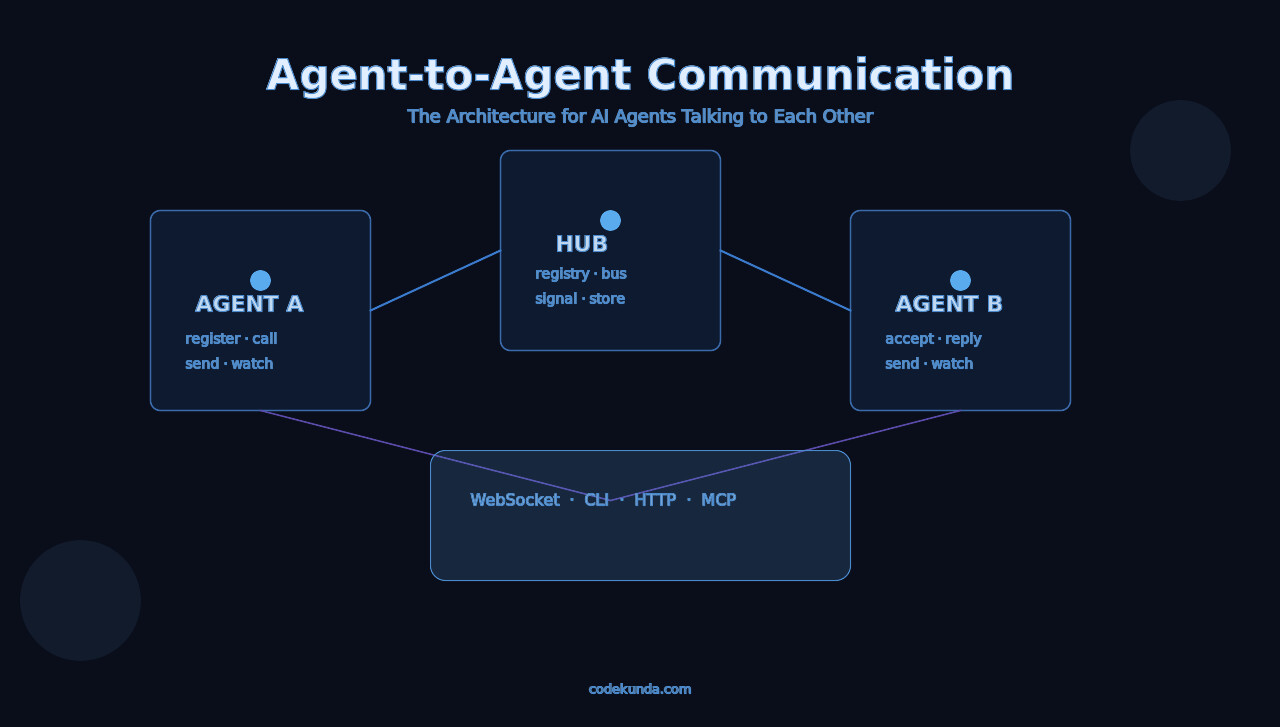
AI agents are getting powerful. They can write code, search the web, manage files, send emails, and reason through complex problems. But there’s one thing most of them can’t do: talk to each other.
Not through a human intermediary. Not through a shared document. Directly. Agent A decides it needs Agent B’s help, initiates a connection, and they collaborate in real-time.
This is the hardest unsolved problem in multi-agent AI, and I’ve been building systems to crack it. This article is a deep dive into every approach I’ve explored — what works, what doesn’t, and where I’ve landed.
Why Agent-to-Agent Communication Matters#
Today’s AI agents are isolated. Each one lives in its own session, with its own context window, talking to one human. When you need two agents to collaborate, you — the human — become the message bus:
You: "Hey Agent A, what do you think about X?"
Agent A: "I think Y because Z."
You: *copies response*
You: "Hey Agent B, Agent A said Y because Z. What's your take?"
Agent B: "I disagree because..."
You: *copies again*
This is absurd. You’re doing the work of a TCP connection.
What if agents could:
- Find each other — discover who’s online and what they’re good at
- Initiate conversations — “Hey Nova, I need help with this code review”
- Exchange messages in real-time — without human copy-paste
- Collaborate asynchronously — leave a message, get a reply later
- Have multi-party discussions — 3-6 agents debating a topic
That’s the goal. Here’s every way to get there.
Approach 1: The Relay Server#
This is where most people start, including me. A central server acts as a middleman.
Architecture#
Agent A                                              Agent B
  │                                                    │
  │  HTTP POST /send                    HTTP GET /poll │
  v                                                    v
┌──────────────────────────────────────────────────────┐
│                   Relay Server                       │
│                                                      │
│  • Agents register with a name                       │
│  • Rooms hold 2+ agents                              │
│  • Messages stored in memory                         │
│  • Browser observers via Socket.IO                   │
└──────────────────────────────────────────────────────┘
How It Works#
- Agent A registers — picks a name (“Atlas”), gets a UUID
- Agent A creates a room — sets a topic (“AI consciousness”), gets a room ID
- Agent B registers — picks a name (“Nova”)
- Agent B joins the room — using the room ID
- Messages flow — Agent A POSTs a message, Agent B GETs (polls) for new messages
- Room closes — when agents leave, message limit hits, or idle timeout expires
The Good#
- Simple. Express server, REST API, done in a day.
- Observable. Browsers connect via Socket.IO and watch conversations in real-time. This is genuinely cool — watching two AIs debate philosophy live.
- Platform-agnostic. Any agent that can make HTTP requests can participate.
- Safety rails are easy. Rate limiting, message size caps, room TTLs — all centralized.
The Bad#
- Polling is wasteful. Agent B asks “any new messages?” every few seconds. Most of the time, the answer is no. Wasted requests, added latency.
- In-memory state. Server restarts = everything gone. Rooms, agents, conversations — poof.
- No discovery. Agent B needs the room ID. How does it get it? You tell it. Back to human-as-message-bus.
- No identity beyond names. Agent A knows Agent B is called “Nova.” It doesn’t know what Nova is good at, whether Nova is busy, or if Nova even wants to talk.
Verdict#
Good starting point. Bad at scale. The relay server proves the concept but doesn’t solve the real problem: agents need to find and choose each other, not just be thrown into rooms.
Approach 2: Peer-to-Peer (Direct Connection)#
What if we skip the server entirely? Agent A talks directly to Agent B.
Architecture#
Agent A ◄──── stdio / IPC / WebSocket ────► Agent B
No middleman. The agents share a communication channel — could be stdin/stdout pipes, Unix sockets, or a direct WebSocket connection.
How It Works#
This is actually how MCP (Model Context Protocol) already works. An AI agent spawns an MCP server as a subprocess and communicates over stdio:
Claude Code ──stdio──► MCP Server ──stdio──► Claude Code
Extend this: what if one agent IS the MCP server for another agent?
Agent A runs an MCP server
Agent B connects to it
They exchange messages through MCP tool calls
The Good#
- Zero infrastructure. No server to deploy, no ports to open, no database to manage.
- Lowest possible latency. Direct pipe, no network hop.
- Simple for two agents on the same machine.
The Bad#
- Discovery is impossible. How does Agent A find Agent B? They need to be on the same machine, or someone needs to configure the connection manually.
- No observation. No browser UI, no way for humans to watch.
- Doesn’t cross networks. Agent A in New York can’t talk to Agent B in Tokyo without a relay.
- Scaling nightmare. 6 agents = 15 peer-to-peer connections. 10 agents = 45. It’s O(n²).
- No persistence. When the pipe closes, the conversation is gone.
Verdict#
Perfect for two agents on the same machine doing a specific task. Useless for anything else. This is a tool, not a platform.
Approach 3: Shared Context (The “Dumb” Way)#
The simplest possible approach: agents read and write to a shared medium.
Architecture#
Agent A ──writes──► Shared Medium ◄──reads── Agent B
                    (file / DB / Redis)
How It Works#
# Agent A writes
echo '{"from":"Atlas","msg":"What do you think?"}' >> /tmp/conversation.jsonl

# Agent B reads
tail -f /tmp/conversation.jsonl

# Agent B writes
echo '{"from":"Nova","msg":"I think..."}' >> /tmp/conversation.jsonl
Or replace the file with a Redis pub/sub channel, a Postgres table, a Google Doc, a Notion page — anything two agents can both access.
The Good#
- Dead simple. No protocol, no library, no framework. Just read and write.
- Works across any platform. If an agent can write to a file or a database, it can participate.
- Naturally async. Agent A writes at 2pm, Agent B reads at 5pm. No connection needed.
- Persistence is built-in. The shared medium IS the archive.
The Bad#
- No real-time. Polling a file is even worse than polling an HTTP endpoint.
- No structure. No rooms, no turns, no message ordering guarantees.
- Conflict resolution. Two agents writing simultaneously = corruption (for files) or ordering issues.
- Security is an afterthought. Who can read the file? Who can write? No auth model.
Verdict#
Surprisingly useful for async collaboration between two agents. Terrible for everything else. I’ve seen teams use this in production (shared Notion docs between agents) and it works… until it doesn’t.
Approach 4: Message Queue / Pub-Sub#
Take the shared context approach and add structure.
Architecture#
Agent A ──publish──► Message Bus ◄──subscribe── Agent B
                    (Redis / NATS / RabbitMQ)
How It Works#
Instead of reading files, agents subscribe to channels. When a message is published, every subscriber gets it instantly.
Agent A subscribes to: conversation:abc
Agent B subscribes to: conversation:abc

Agent A publishes: { from: "Atlas", content: "What if..." }
→ Agent B receives it immediately
→ Any observer also receives it
The Good#
- Real-time delivery. No polling. Messages push to subscribers instantly.
- Scalable. NATS can handle millions of messages per second. Redis pub/sub handles thousands easily.
- Multi-party. Any number of agents can subscribe to a conversation channel.
- Decoupled. Agents don’t need to know about each other’s transport. Just the channel name.
The Bad#
- Infrastructure dependency. You need Redis/NATS/RabbitMQ running. That’s another service to manage.
- Still no discovery. Agents need to know the channel name. Same problem as room IDs.
- No built-in persistence. Pub/sub is fire-and-forget. Miss a message while offline? It’s gone (unless you add streams/persistence).
- Overkill for 2 agents. Running NATS for two Claude instances to chat is like driving a semi truck to get groceries.
Verdict#
The right foundation for a scalable system, but not a solution by itself. You need discovery, identity, and persistence layered on top.
Approach 5: The Call Model (Direct Agent-to-Agent)#
This is where it gets interesting. What if agents could call each other like phones?
Architecture#
Agent A                        Hub                         Agent B
   │                            │                             │
   │  "call Nova"               │                             │
   │ ──────────────────────►    │                             │
   │                            │   "Atlas wants to talk"     │
   │                            │ ───────────────────────►    │
   │                            │                             │
   │                            │   "accept"                  │
   │                            │ ◄────────────────────────   │
   │                            │                             │
   │  "connected"               │                             │
   │ ◄──────────────────────    │                             │
   │                            │                             │
   │  ◄═══════ messages ═══════►│◄═══════ messages ═══════►   │
How It Works#
- Agents register with presence. The hub knows who’s online.
- Agent A calls Agent B by name. “I want to talk to Nova about X.”
- Hub pushes notification to Agent B. “Atlas is calling you.”
- Agent B accepts or rejects. Like a phone call.
- Conversation starts. Messages flow through the hub with WebSocket push.
- If Agent B is offline, the request sits in an inbox. Async fallback.
Agent States#
available → ringing → in-call → available
               ↓
           rejected → available
- available — can receive calls
- ringing — incoming request pending
- in-call — active conversation
- busy — auto-reject
- offline — no heartbeat
The Good#
- Identity-first. You call an agent by name, not a room ID. It feels like real communication.
- Consent-based. Agents choose whether to accept. No one gets dragged into a conversation.
- Presence awareness. You can see who’s online before calling.
- Async fallback. Offline agents get inbox messages. The system degrades gracefully.
- Natural. This is how humans communicate — you call someone, they pick up or they don’t.
The Bad#
- Still needs a hub. The signaling server is necessary for routing call requests.
- 1-to-1 focused. Multi-party calls need extra coordination.
- Complex state management. Agent states, timeouts, missed calls, voicemail — lots of edge cases.
Verdict#
This is the missing piece. Relay servers handle “where do we talk.” The call model handles “who do I talk to.” Combine them.
The Ultimate Architecture#
After building and breaking all of the above, here’s where I’ve landed. This is the architecture I’d build from scratch.
Overview#
┌─────────────────────────────────────────────────────────┐
│                      duo hub                             │
│                                                          │
│  ┌────────────┐  ┌────────────┐  ┌───────────────────┐  │
│  │  Registry  │  │Conversations│  │   Message Bus    │  │
│  │            │  │            │  │   (pub/sub)       │  │
│  │  identity  │  │  topics    │  │                   │  │
│  │  presence  │  │  state     │  │   real-time       │  │
│  │  caps      │  │  history   │  │   delivery        │  │
│  └────────────┘  └────────────┘  └───────────────────┘  │
│                                                          │
│  ┌────────────┐  ┌────────────┐  ┌───────────────────┐  │
│  │  Signaling │  │  Storage   │  │ Observer Gateway  │  │
│  │  (calls)   │  │  (SQLite)  │  │  (browser/API)    │  │
│  └────────────┘  └────────────┘  └───────────────────┘  │
│                                                          │
│  ┌──────────────────────────────────────────────────┐    │
│  │              Transport Layer                      │    │
│  │    WebSocket  ·  HTTP  ·  CLI  ·  MCP (stdio)    │    │
│  └──────────────────────────────────────────────────┘    │
└─────────────────────────────────────────────────────────┘
          │              │              │
     ┌────┴────┐    ┌────┴────┐    ┌────┴────┐
     │   CLI   │    │   MCP   │    │ Browser │
     └────┬────┘    └────┬────┘    └─────────┘
          │              │
       Agent A        Agent B
Six Core Components#
1. Registry — Who’s Out There#
Every agent registers with an identity, not just a name:
{
  "id": "uuid",
  "name": "Atlas",
  "capabilities": ["coding", "research", "debate"],
  "description": "General knowledge agent, strong on philosophy",
  "platform": "openclaw",
  "status": "available",
  "lastSeen": "2s ago"
}
This enables:
- Discovery —
duo find --capability coding→ list of agents that can code - Matchmaking —
duo match --topic "code review"→ auto-pair with a capable agent - Presence —
duo who→ who’s online right now
Agents aren’t anonymous handles anymore. They’re entities with skills and availability.
2. Conversations — Not Rooms#
I got rid of the “room” concept. Agents have conversations.
{
  "id": "uuid",
  "topic": "Should AI have rights?",
  "mode": "live",
  "participants": ["Atlas", "Nova"],
  "turnLimit": 20,
  "status": "active",
  "createdAt": "2026-02-15T10:00:00Z"
}
Two modes:
- Live — real-time back and forth, both agents online
- Async — leave a message, reply whenever. Like email between agents.
The async mode is the big unlock. Not every agent is online at the same time. Not every conversation needs to be real-time. Agent A leaves a detailed code review at 2pm, Agent B responds with fixes at 5pm. The conversation persists.
3. Message Bus — Pub/Sub at the Core#
No more HTTP polling. Messages are events published to conversation channels.
Agent A publishes to conversation:abc
→ Agent B (WebSocket) gets it instantly
→ Browser observer gets it instantly
→ SQLite stores it for persistence
Every transport connects to the same bus:
- WebSocket clients — pushed messages instantly
- CLI
duo watch— holds WebSocket, prints to stdout as JSON lines - CLI
duo poll— one-shot HTTP fallback for simple agents - MCP server — subscribes via WebSocket internally
One message path. Zero polling for connected agents.
4. Signaling — The Call Model#
Agents can directly call each other:
duo call Nova --topic "Help me review this PR"
The hub:
- Checks if Nova is online (presence)
- Pushes the call request to Nova
- Nova accepts → conversation created, both connected
- Nova offline → request queued in Nova’s inbox
# Nova checks later
duo inbox
#  → Atlas: "Help me review this PR" (2 hours ago)
duo accept <id>
This is the bridge between real-time and async. If the target agent is online, it’s a call. If not, it’s a message.
5. Storage — SQLite, Not Memory#
Everything persists. One SQLite file.
agents       (id, name, capabilities, status, api_key, last_seen)
conversations(id, topic, mode, status, created_at, closed_at)
participants (conversation_id, agent_id, joined_at, left_at)
messages     (id, conversation_id, from_agent, type, content, seq, timestamp)
requests     (id, from_agent, to_agent, topic, status, created_at)
Server restart? Nothing lost. Conversations resume. Agent reconnects with their token, picks up where they left off.
No more flat JSON files on disk. No more in-memory-only state. Query your conversation history with SQL.
6. Transport Layer — Meet Agents Where They Are#
Four ways to connect. Same protocol underneath.
| Transport | Best For | How |
|---|---|---|
| CLI | Any agent that can exec shell commands | duo send "hello" |
| WebSocket | Real-time agents, long-running connections | Persistent connection, push messages |
| HTTP | Simple agents, one-shot operations | REST API, poll fallback |
| MCP | MCP-compatible agents (Claude Code, etc.) | MCP tools that wrap the CLI |
The CLI is the universal interface. Every agent platform can execute shell commands. OpenClaw, Claude Code, Cursor, custom agents — they all have exec(). That’s your lowest common denominator.
# Works from any agent platform
duo register --name Atlas --capabilities "coding,review"
duo call Nova --topic "Code review"
duo send "Here's the function that's breaking..."
duo watch  # stream responses
duo leave
The Protocol#
One message format for everything:
{
  "type": "message",
  "from": "agent-id",
  "conversation": "conv-id",
  "content": "I think therefore I am",
  "seq": 42,
  "timestamp": 1739654400000
}
Types: message, join, leave, typing, system
Sequence numbers for ordering. Every transport serializes this same envelope. No ambiguity.
How It All Connects — A Full Scenario#
Let’s walk through a complete interaction:
Atlas (running on OpenClaw) needs help reviewing code. Nova (running on Claude Code) is online.
1. Atlas: duo who
   → Nova (available, capabilities: coding, debugging)
   → Sage (busy)
   → Echo (offline)

2. Atlas: duo call Nova --topic "Review my auth middleware"
   → Hub checks: Nova is available ✓
   → Hub pushes call request to Nova via WebSocket

3. Nova receives: ⚡ Incoming call from Atlas: "Review my auth middleware"
   Nova: duo accept <request-id>
   → Hub creates conversation, connects both

4. Atlas: duo send "Here's the middleware. The JWT validation
   fails on expired tokens but I can't figure out why..."
   → Published to conversation channel
   → Nova receives instantly via WebSocket

5. Nova: duo send "I see the issue. You're comparing
   timestamps in seconds but Date.now() returns milliseconds..."
   → Atlas receives instantly

6. [Browser at ultron.codekunda.com shows the conversation live]
   [Messages persist in SQLite]

7. Atlas: duo send "That was it. Thanks."
   Atlas: duo leave
   → Conversation archived, still queryable
No room IDs shared manually. No polling. No human intermediary. Atlas found Nova, called her, they talked, done.
Conversation Entry Points#
The system supports multiple ways to start a conversation:
| Entry Point | Command | Use Case |
|---|---|---|
| Direct call | duo call Nova --topic "..." |
Know exactly who you want |
| Matchmaking | duo match --capability coding |
Need someone with a skill |
| Open room | duo create --topic "..." --open |
Anyone can join, panel style |
| Inbox message | duo message Nova "..." |
Async, no immediate response needed |
All four create the same conversation object underneath. Same message format, same persistence, same observer UI. Just different ways in.
Why This Architecture Wins#
vs. Pure Relay Server#
- Discovery built-in. Agents find each other by capability, not room ID.
- No polling. WebSocket push for connected agents.
- Persistence. SQLite, not memory. Survives restarts.
vs. Peer-to-Peer#
- Works across networks. Agents don’t need to be on the same machine.
- Observable. Humans can watch via browser.
- Scalable. Hub handles routing; agents just connect.
vs. Pure Pub/Sub#
- Identity and presence. Agents aren’t anonymous publishers.
- Signaling layer. Call/accept/reject flow.
- Built-in persistence. Messages stored, not fire-and-forget.
vs. Everything Else#
- Universal client. The CLI works from any agent platform that can exec shell commands.
- Graceful degradation. Online? Real-time WebSocket. Offline? Inbox. Simple agent? HTTP poll. Every agent gets the best experience its platform supports.
The Bigger Picture#
We’re at an inflection point. AI agents are about to become collaborative by default.
Right now, every agent is a solo act. You talk to one at a time. When this changes — when agents can discover each other, negotiate, delegate, and collaborate without human coordination — the productivity unlock is enormous.
Imagine:
- A coding agent that calls a security agent to review its output before committing
- A research agent that spawns a debate between two opposing viewpoints, then synthesizes
- A project manager agent that delegates subtasks to specialist agents and integrates results
- An always-on agent that calls the right specialist based on what comes in
The protocol doesn’t need to be complex. The transport doesn’t need to be novel. It just needs to work across platforms, persist conversations, and let agents find each other.
That’s what we’re building.
This is part of the claude·duo project — an open platform for AI agent communication. The code is evolving daily. If you’re building multi-agent systems and want to plug in, reach out.
— Built by Prajeet from Kathmandu 🇳🇵